
Students Aren’t Struggling to Read — They’re Struggling to Know
There is a common belief amongst not just teachers, but also more broadly in society that if a students can read the words on a page, they should be able to understand the meaning of those words.
So when students don't understand, or show poor critical thinking about the ideas they were reading about, we look for explanations:
low ability
lack of effort
poor focus
Or we reach for solutions:
simplify the text
select topics and texts not based on what we think is valuable but what we think is "engaging"
differentiating the task - often lowering expectations for students
But what if the real issue is something far less visible?
What if students can’t understand the text because they don’t have the knowledge the text assumes?
Why Students “Can’t Read” — And What Teachers Can Actually Do About It
I remember in one end-of-year planning session, my teaching team were debating whether to continue teaching Gattaca in Year 10. One teacher was strongly opposed, arguing that the film was outdated and that students couldn’t relate to it, so they found it boring.
I found that surprising because I had the opposite experience. My students were deeply engaged. We had rich discussions and strong analytical writing on the central ideas - questions about whether our potential is predetermined, or whether effort and persistence can shape who we become. These are powerful, enduring, and above all, fascinating, ideas.
But the difference wasn’t the film. It was what students knew before they watched it.
Nothing is inherently boring if you already have enough knowledge and schema to make sense of it. What appears to be “disengagement” is often confusion. When students don’t understand the ideas, they can’t connect, question, or think critically, so they switch off.
In my classroom, I didn’t expect the film to do the heavy lifting. Before we watched it, we spent time unpacking the key ideas, merit, genetic engineering, fairness, effort, and success. These concepts were the "background knowledge" students needed before they could understand the film. By the time we got to the film, students weren’t trying to figure out what was going on; they were using what they knew to think more deeply. The film wasn’t the starting point, it was an opportunity to extend and refine their thinking.
This is the essence of the L4L method: students need to be prepared to read, watch, and think. Without that preparation, even the most interesting texts and ideas fall flat. With it, almost any text or idea becomes engaging.
This situation plays out in classrooms everywhere.
Walk into almost any secondary classroom and you’ll hear a familiar refrain:
“They just won't read.”
“They don't find this topic interesting.”
“This topic or text is too hard.”
At some point, it begins to feel inevitable, as though literacy sits outside the teacher’s control. A fixed problem. A student deficit.
But what if that diagnosis is wrong?
What if the issue isn’t that students can’t (or won't) read, but that we are asking them to read before they are ready to understand?
The hidden problem: students are expected to learn through reading or watching
By the middle years of schooling, reading is no longer the goal, it becomes the vehicle for learning.
In English, students are expected to analyse novels.
In Humanities, they interpret sources and read textbooks.
Across subjects, they encounter dense, abstract, unfamiliar texts.
And yet, many students hit a wall. Although they can read the words on the page, they can't really make sense of their meaning.
So they disengage and avoid doing the work. Ultimately they rely on the teacher to "explain it".
From the outside, it looks like low ability or low motivation.
But often, it’s something else entirely.
The problem we can’t see
One of the most powerful insights from the Science of Reading is this:
Comprehension depends on knowledge.
Not general ability or “reading skills.”
But specific, topic-based knowledge.
The problem is that this knowledge is often invisible. As teachers, we already have it and therefore we underestimate how much prior knowledge we’re bringing to the text.
When I watch Gattaca, my brain is automatically engaging in the ideas the film is exploring, I'm not even thinking about it.
But many students don’t have (or have incomplete) prior knowledge and therefore their brain actually cannot understand or engage with the ideas texts or sources are presenting. So when we hand them a textbook, a source, or a novel, we’re not just asking them to read.
We’re asking them to:
interpret unfamiliar concepts
connect ideas they’ve never heard of before, or that they have a very shallow understanding of
infer meaning from gaps they cannot fill
And then we see those same students struggle.
Why avoiding reading doesn't solve the problem
When students struggle to read, or say that they find it boring and won't engage, the natural response is to stop asking them to read independently. Instead we often feel that we are responsible for teaching them everything they need to know before the assessment. We explain more, simplify more, present more.
In practice, this often becomes a kind of “death by PowerPoint,” where we attempt to compress an entire unit’s worth of knowledge into teacher explanation. It feels efficient, even supportive. After all, if students can’t access the text, we’ll just give them the information directly.
But this approach creates two new problems.
First, students never develop the capacity to read and learn from complex texts independently, which is ultimately the goal of schooling, particularly in the secondary years. Second, and more importantly, complex ideas do not lend themselves to this mode of delivery. They cannot be fully grasped through explanation alone. Depth requires time, complex language, and sustained engagement with an idea as it unfolds.
This is where reading matters. Not as an isolated “skill,” but as the medium through which depth of thought and understanding develops.
Let's consider a concept like colonisation. To understand this complex concept students need to understand:
the importance of land to a person's identity
power and control
the idea of ownership (and how that differs across cultures)
impact on existing populations
economic motives
cultural and environmental consequences
In one classroom, the teacher might present these points through slides: a short definition, explain the key features of colonisation, provide a few key points, perhaps an example. Students copy notes, answer a few questions, and move on. They might even read a few pages of a textbook and answer the questions. Everything appears to be “covered.”
However, to truly understand the complexity and nuance, students need to engage in extended readings that explore some of these ideas in depth. We would still begin with explicit instruction - carefully introducing the core ideas of colonialism and the essential knowledge students need. But then we support students to read a nuanced, well-chosen source that explores colonisation in context: its impact on land, people, and culture. They are guided through that reading, asked to interpret, question, and connect ideas, before writing about what they have understood.
The activity of reading allows us to build depth of understanding. But it needs to happen once students are able to engage in reading.
It is very difficult to build depth of understand through a series of slides and short answer questions. That's because to understand complex ideas like colonialism, students need to understand shades of meaning in a network of ideas: power, land, economic motivation, competing worldviews, long-term consequences. Teacher instruction is vital, but can leave students with a shallow impression or understanding of those concepts.
The same dynamic plays out in English classrooms, but it is easier to miss.
Take a concept like belonging. We often assume students understand it. But meaningful analysis depends on far more than a definition and a few examples. Students need to grasp distinctions: belonging by choice versus obligation, inclusion versus exclusion, the role of power, the ways belonging can be constructed or denied.
Without that knowledge, reading a novel does not deepen understanding, the novel will be meaningless, and therefore "boring".
Students fall back on vague responses - not because they lack ability, but because they lack the conceptual schema to think with.
Avoiding reading, then, does not solve the problem. It delays it.
Students may succeed in the short term, supported by teacher explanation, but they remain dependent. They have not developed the knowledge, or the habits of mind, required to engage with complex ideas on their own.
The challenge is not to replace reading with explanation, but to prepare students so that reading becomes possible, and then to use it to deepen understanding.
The shift: teach the knowledge required to understand the text before reading
Many teachers do teach "context" before reading. We show the map where a novel is set, explain a historical period, define a few key terms.
But this often misses the point.
It’s not about giving students just enough background to understand what happens in a text.
It’s about teaching the conceptual schema the text is exploring, and then using reading to extend and refine that knowledge.
This is the shift at the heart of the L4L method:
Teach → Read → Write → Repeat
Or more precisely:
Teach ideas and key knowledge
Read to deepen and extend understanding
Write to refine and clarify thinking
Repeat the cycle
Reading is no longer the starting point. It is the deepening phase.
Writing is no longer just assessment. It is part of the thinking process.
What this looks like in practice
Returning to colonisation, a sequence might look like this:
1. Teach the concept explicitly
Break it into its components: what it is, why it happens, who it affects, and how perspectives differ.
2. Move to a focused reading
A short, carefully selected passage that reinforces and extends this knowledge.
3. Guide the reading
Through questions that push beyond surface understanding:
What does this reveal about power?
Whose perspective is missing?
4. Ask students to write
Using structured support — vocabulary, sentence stems, clear expectations.
5. Provide feedback that builds knowledge
Not just correcting errors, but extending and refining understanding.
This is not about adding more.
It is about sequencing learning so that each stage makes the next possible.
If you’re trying to build this kind of sequence into your own units — particularly when working with complex texts — this is exactly the work we unpack step-by-step in my workshop on scaffolding challenging ideas and texts.
Why this changes everything
To understand why this matters, it helps to clarify a long-standing imbalance in classrooms.
We often prioritise procedural knowledge:
analysing
inferring
evaluating
But these skills depend on declarative knowledge:
facts
concepts
vocabulary
ideas
You cannot analyse what you do not understand.
When knowledge is missing, skills collapse into guesswork.
When knowledge is secure, those same skills become powerful.
This is why some students appear “naturally analytical.” In reality, they have more to think with.
So what needs to change?
Not everything.
But one shift matters:
We need to make the invisible knowledge visible — and teach it deliberately.
This means:
identifying the essential idea
mapping the knowledge students need
sequencing it carefully
using reading and writing to deepen understanding over time
Not replacing rigour —
but finally making it possible.
A practical next step
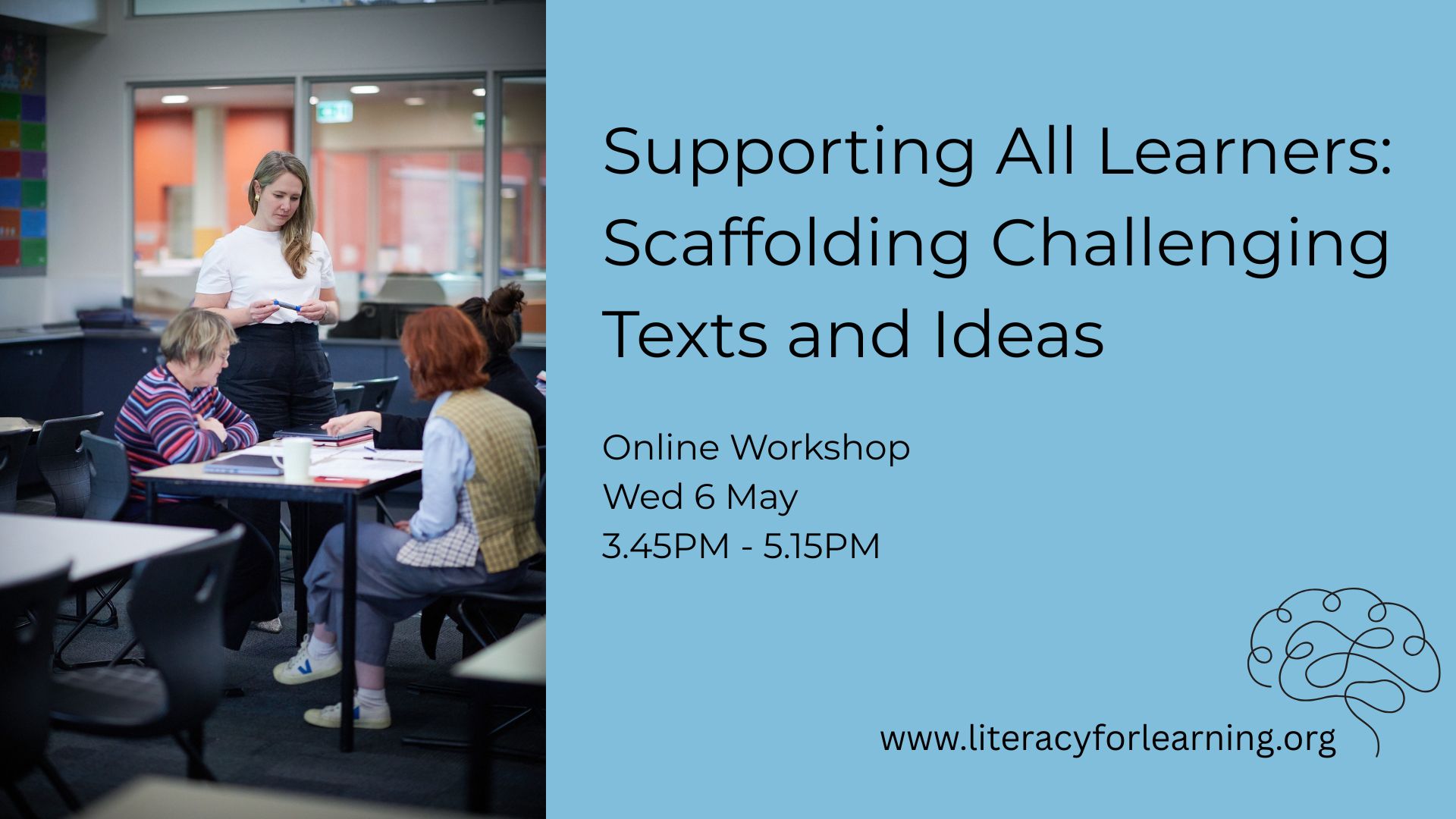
If this resonates — if you’ve seen students struggle with texts, produce surface-level writing, or disengage despite your best efforts — this is exactly the problem we tackle in:
Supporting All Learners: Scaffolding Challenging Texts and Ideas
In this workshop, you’ll learn how to:
build a clear sequence from knowledge to writing
scaffold complex texts without oversimplifying them
design lessons that reduce overwhelm while increasing rigour
support all students to think more deeply — not just complete tasks
👉 Sign up here: Supporting All Learners: Scaffolding Challenging Texts and Ideas
