Upcoming professional learning
Our professional learning supports teachers to apply the science of learning in real classrooms.
Join our upcoming workshop
Join our upcoming workshop
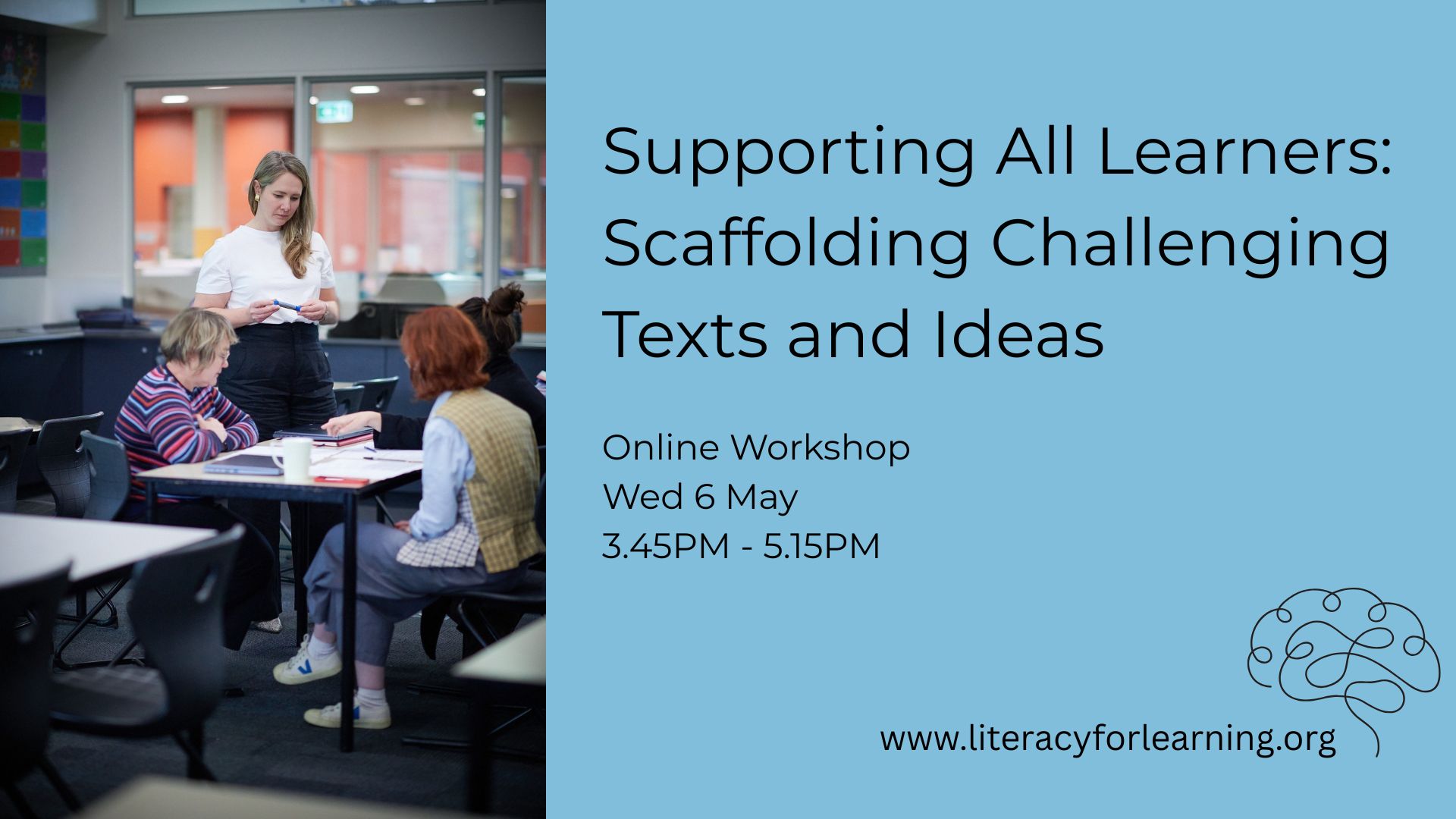
Supporting All Learners: Scaffolding Challenging Texts and Ideas
Supporting All Learners: Scaffolding Challenging Texts and Ideas
Monday February 16
Online
6.30PM - 7.30PM (AEDT)
Wednesday May 6
Online
3.45PM - 5.15PM (AEDT)
$59
This session will be recorded
Wednesday May 6
Online
3.45PM - 5.15PM (AEDT)
$59
This session will be recorded
Join this hands-on online workshop that will support you to plan effective lessons that enable all students to access complex texts and material - from novels to historical sources to subject matter content. This session is tailored to secondary teachers but is equally applicable to primary teachers seeking to engage students with complex ideas and material.
What the workshop covers
This session will provide teachers with an evidence-based, practical approach to ensure all students successfully access and learn from year-level text and subject materials. Participants will learn how to plan scaffolded lessons that maintain rigour while ensuring students are prepared to engage with complex texts and ideas. The session will demonstrate a clear, structured approach to preparing students before reading, guiding their understanding during learning, and consolidating thinking for stronger writing outcomes.
Registration process supports payment by invoice.
Join this hands-on online workshop that will support you to plan effective lessons that enable all students to access complex texts and material - from novels to historical sources to subject matter content. This session is tailored to secondary teachers but is equally applicable to primary teachers seeking to engage students with complex ideas and material.
What the workshop covers
This session will provide teachers with an evidence-based, practical approach to ensure all students successfully access and learn from year-level text and subject materials. Participants will learn how to plan scaffolded lessons that maintain rigour while ensuring students are prepared to engage with complex texts and ideas. The session will demonstrate a clear, structured approach to preparing students before reading, guiding their understanding during learning, and consolidating thinking for stronger writing outcomes.
Registration process supports payment by invoice.
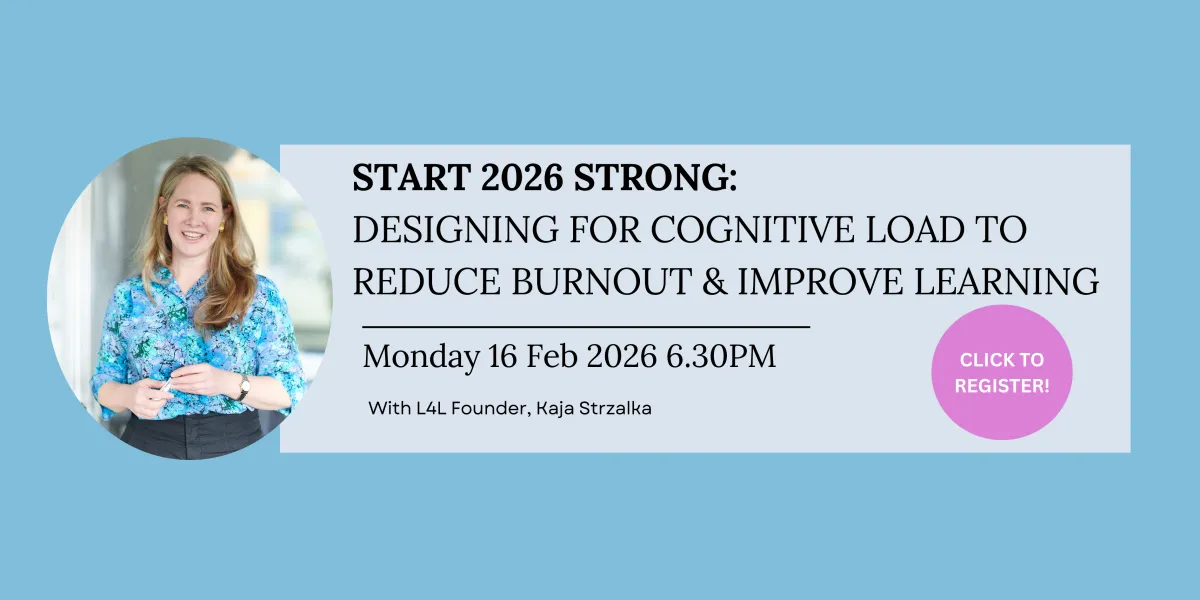
Our first PD of the year focuses on how to use Cognitive Load Theory to make planning easier and ensure learning transfers beyond the lesson, especially for struggling students.
“Understanding Cognitive Load Theory has been the biggest game-changer for my teaching and my students’ learning.”
We hear this from teachers all the time, so this is what we wanted to start the year with.
This free webinar will focus on a foundational idea that can make a real difference to how your classroom runs day to day.
If you’ve ever felt pressure to cram content into a unit, found it difficult to engage struggling students, or wondered why students forget what you’ve taught, this first session is for you.
Detail
In this session you will learn how to
In this session you will learn how to
Use principles from Cognitive Load Theory to reduce student overwhelm and support students to successfully engage with complex content
Design an effective essential idea to focus your students' thinking and reduce overload
Build the knowledge students need before reading
Structure lessons that support both struggling and high-achieving students
Maintain rigour while making content accessible
Lay the groundwork for students to engage in extended responses and analytical writing
You will be provided with a practical approach that shows what to teach before students read, so they can successfully understand and engage with complex texts and ideas.
During this session, participants will learn from modelled examples and also by doing - applying the approaches to real classroom texts and ideas.
What you'll walk away with
A clear sequence of lessons that will lay the foundations for a written response
A planning template to replicate the process
A model for scaffolding novels, articles and any other complex, subject-based texts
A clear idea of how to engage students - including what to teach, in what order, and why
A clear sequence of lessons that will lay the foundations for a written response
A planning template to replicate the process
A model for scaffolding novels, articles and any other complex, subject-based texts
A clear idea of how to engage students - including what to teach, in what order, and why
This session is for you if
Your students struggle to understand what they read
You’re teaching novels, analysis of sources, or content-heavy topics
You’re expected to differentiate but it feels unsustainable
Students struggle to produce strong written responses
Limited spots available to allow for feedback and support.
Who should attend
Secondary English and Humanities teachers (Years 7–11) and Primary Teachers working with mixed-ability classes where students struggle to access complex texts and content. Learning and literacy specialists and leading teachers driving school-wide approaches to curriculum development and pedagogical practices.
This workshop focuses on what to teach to prepare students for reading and writing. Future sessions will explore vocabulary, close reading, and writing instruction in more depth.
Please note, there will be some optional pre-work for the workshop.
Why students struggle and disengage
Why unit and lesson design matters more than motivation or engagement
Why some learning endures beyond the lesson and other learning is forgotten
How teaching that works with the brain supports both learners and teachers
Who should attend
Secondary English and Humanities teachers (Years 7–11) and Primary Teachers working with mixed-ability classes where students struggle to access complex texts and content. Learning and literacy specialists and leading teachers driving school-wide approaches to curriculum development and pedagogical practices.
This workshop focuses on what to teach to prepare students for reading and writing. Future sessions will explore vocabulary, close reading, and writing instruction in more depth.
Please note, there will be some optional pre-work for the workshop.
Why students struggle and disengage
Why unit and lesson design matters more than motivation or engagement
Why some learning endures beyond the lesson and other learning is forgotten
How teaching that works with the brain supports both learners and teachers
Stay up to date new posts and PD opportunities
Read our latest posts
Students Aren’t Struggling to Read — They’re Struggling to Know
Why do students struggle with reading comprehension, even when they can decode the words on the page? The answer may not be reading ability at all. ...more
Science of Learning ,L4L System Science of Reading Cognitive Load Theory Teaching Critical Thinking Teacher Wellbeing & Professional Practice Secondary Teaching Curriculum & Instruction &Cognitive Science in Education
April 18, 2026•10 min read

Stop teaching reading comprehension and start teaching knowledge – 4 reasons why this is a critical shift every teacher needs to make
Are reading comprehension strategies enough? The science of reading suggests otherwise. Discover four key reasons why building knowledge—not just practising comprehension skills—is essential for impro... ...more
L4L System ,Science of Reading Cognitive Load Theory Teaching Critical Thinking Teacher Wellbeing & Professional Practice Teacher Burnout Secondary Teaching Curriculum & Instruction &Cognitive Science in Education
April 17, 2026•14 min read

Beyond Differentiation: Why Better Unit Design — Not More Adjustments — Supports Every Student
Why differentiation often fails — and how cognitive load theory reshapes unit design to support struggling and high-achieving students. ...more
Science of Learning ,Cognitive Load Theory Curriculum & Instruction &Cognitive Science in Education
March 04, 2026•6 min read