
Stop teaching reading comprehension and start teaching knowledge – 4 reasons why this is a critical shift every teacher needs to make
My initial teacher education did not equip me with adequate knowledge on the Science of Reading and Learning. This caused me to rely on ineffective reading comprehension and literacy practices that tired me out. Most critically, these practices also weren’t working for my kids. My hope is that this post empowers you to take control of your classroom in a way that supports both you AND your students.
I remember my first month in the classroom and how excited I was to teach ‘To Kill a Mockingbird’ with my Year 11s. I had prepared so many interesting and engaging activities that would get the students thinking deeply about all the important issues in the novel. Right? Wrong!
What struck me was that my students couldn’t read and understand the text. All my activities were useless because the students didn’t know what happened, and more importantly, couldn't understand the ideas in a deep or meaningful way.
And so began my many year long journey to understand the Science of Learning and ultimately to develop the L4L method.
Everything changed when I discovered the missing link. Teaching became more joyful, my students more engaged and my workload lessened.
That missing link was discovering the role of knowledge in comprehension.
What we explore in this post:
What is reading comprehension?
Reason 1: Reading comprehension is not a skill and is not teachable.
Comprehension skills v strategies
The confronting implication of the importance of knowledge in reading ability
Students may have insufficient or incorrect background knowledge
The difference between activating prior knowledge and building knowledge
Building knowledge fights inequities in the classroom
Not teaching background knowledge forces us to differentiate more
Reason 3: By building knowledge we snowball students’ learning.
Reason 4: Teaching background knowledge reduces teacher burnout and stress
What is reading comprehension?
Reading is a very complex process and many teachers don’t have an expert understanding of it. Unsurprisingly, many students struggle with reading despite teachers trying their guts out.
Scarborough’s Reading Rope (image below) is a useful representation of the various elements that make up skilled reading. The two key “strands” of reading are word recognition and language comprehension. Comprehension itself is a complex process that is made up of many elements. Without discounting the importance of the other elements, this post focuses on building students’ background knowledge and why that is crucial.
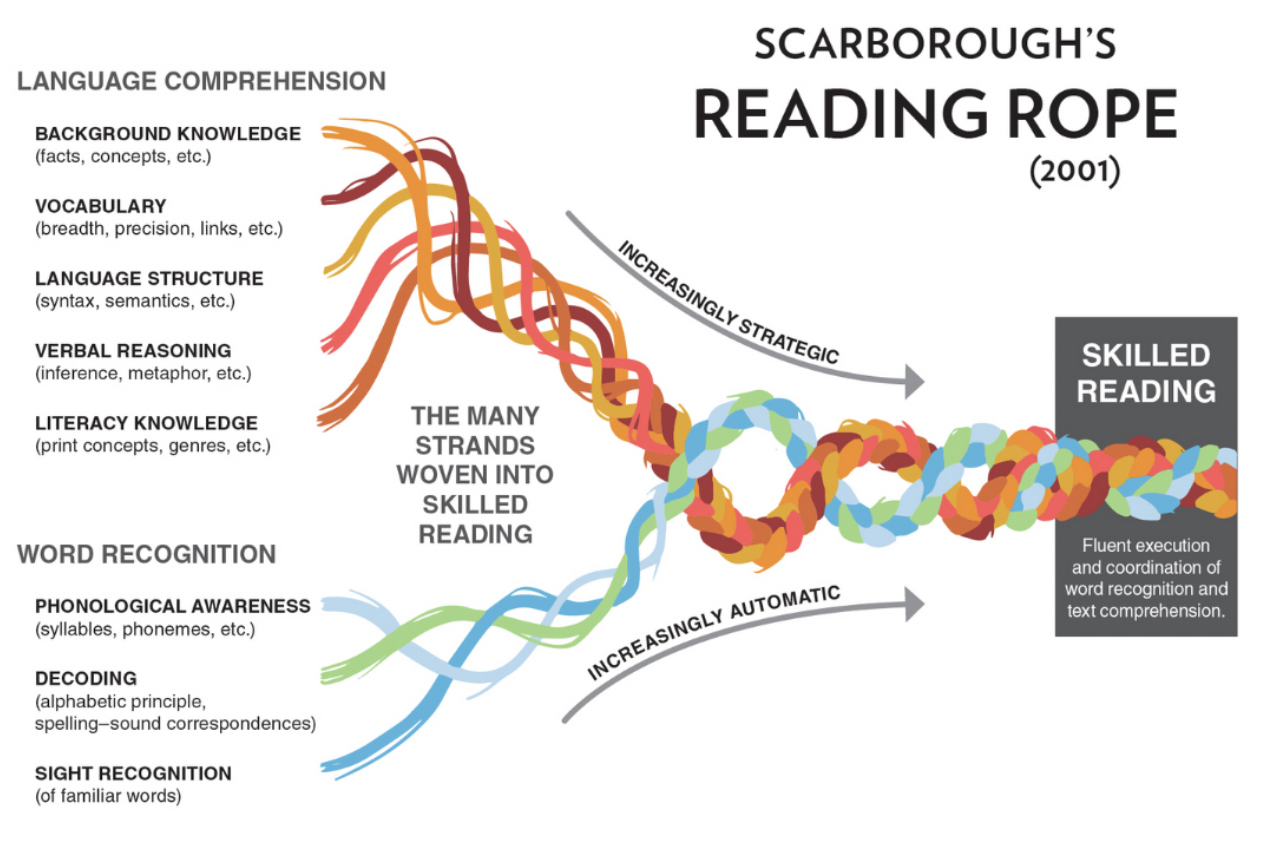
Reading is a complex process. This post focuses on the importance of background knowledge. A version of the image above originally appeared in the following publication: Scarborough, H. S. (2001). Connecting early language and literacy to later reading (dis)abilities: Evidence, theory, and practice. In S. Neuman & D. Dickinson (Eds.), Handbook for research in early literacy (pp. 97–110). New York, NY: Guilford Press.
4 reasons why you should stop teaching reading comprehension and start teaching background knowledge.
Once you change your focus, your teaching life will never be the same.
Reason 1: Reading comprehension is not a skill and is not teachable.

Reading is not a skill like throwing in sport.
Reading comprehension is a process not a skill. Surprising, I know. But because of this, we cannot teach it like a transferable skill.
Let me give you an example. Throwing is a skill. You practice it over and over again to become faster or able to throw further. However, gaining meaning from text is not a skill that will improve just by doing it over and over again. This is because comprehending is a process whereby the textual information needs to merge with students’ pre-existing information to create new meaning. Something like this:
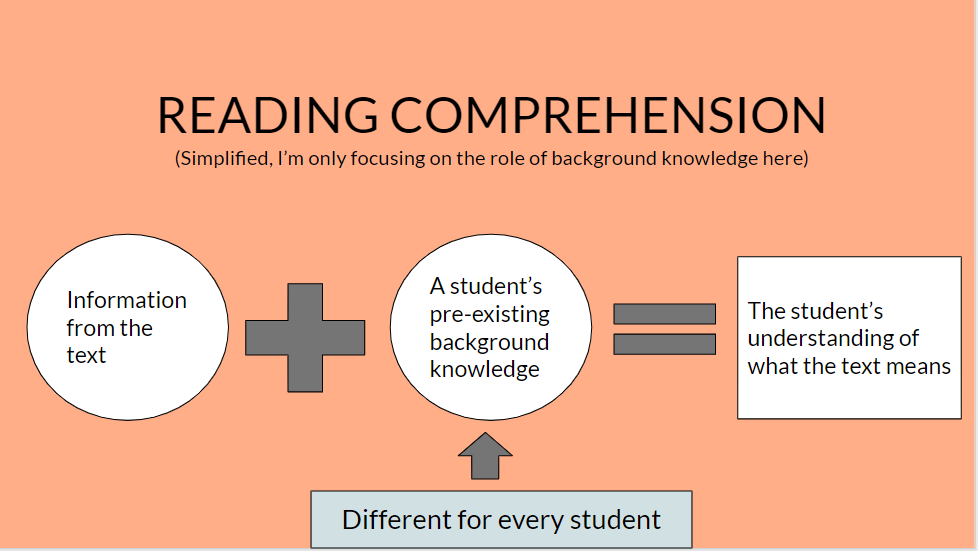
Students rely on their background knowledge to form an understanding of text.
The most compelling evidence to demonstrate this is the “baseball” reading test.
Researchers took a group of students and gave them a reading on baseball. They found there was no difference in reading comprehension, at least when it came to a literal understanding of text, between the apparently “weak” and “strong” readers in cases where the “weak” readers had a high degree of background knowledge on the topic.
While surprising at first, this makes perfect sense. How can you find the main idea in a text, or draw conclusions, unless you first have some understanding of the topic that the text is about? We have been approaching reading comprehension backwards.
Comprehension skills v strategies
It’s important to note that there is a difference between comprehension skills and comprehension strategies. Comprehension skills are abilities that can be used after reading to answer questions about the text such as, identifying the main idea, recognizing supporting details, drawing conclusions, inferencing, comparing and contrasting, evaluating critically, knowing vocabulary meaning, and sequencing events. Comprehension strategies are actions that may help a reader to figure out and remember the information from a text while reading, such as monitoring for information, summarising and questioning.
There is limited evidence that teaching comprehension skills has any effect on reading comprehension. Some researchers go as far as to argue that the reading comprehension skills we are teaching are actually the outcomes of comprehension rather than teachable skills.
Comprehension strategies on the other hand, have been shown to improve reading comprehension. However, research suggests that beyond 10 sessions, teaching reading comprehension strategies has no, or minimal, effect on reading and this should not be a long-term practice in classrooms.
That’s because comprehension is about making meaning. Strategies can support students when they get stuck, but they don’t build comprehension in themselves. Once students understand how to use them, repeated practice adds little value. The real lever is knowledge, because what students know determines how well they understand.
The confronting implication of the importance of knowledge in reading ability
A significant amount of our primary (and even secondary) instruction, reading or otherwise, focuses on teaching skills and strategies to understand ideas in text. It makes sense why. We all know how reading achievement impacts on the health, wealth and socioeconomic outcomes of our students. It would be wonderful if students could just master the “skill” of comprehension and then they could read anything.
The confronting reality is that reading comprehension relies on years of general knowledge built up over time.
This is a slow process and one where differences are exacerbated by a student’s level of disadvantage. That feels uncomfortable.
Spending time building our students’ knowledge and making sure they consolidate it into their long-term memory is a daunting task. It is not a scaleable process that is easily sold in an off the shelf product. It is not easily tested on commercial reading tests. There’s nothing quick and easy about this method. It requires deep thinking by teachers and is a slow process, but…it is also interesting and stimulating. It provides teachers with an exciting opportunity to help students uncover wondrous and amazing things about our world. When I stopped teaching reading comprehension and started focusing on the ideas and knowledge I knew was vital for students to know, I personally regained my passion and joy of being in the classroom.
Students may have insufficient or incorrect background knowledge
Students rely on their background knowledge to determine meaning from a text. If a student has no, or insufficient, background knowledge on a topic, then a student cannot make sense of the information they are digesting. Worse still, students may consolidate incorrect understandings into their long-term memory.
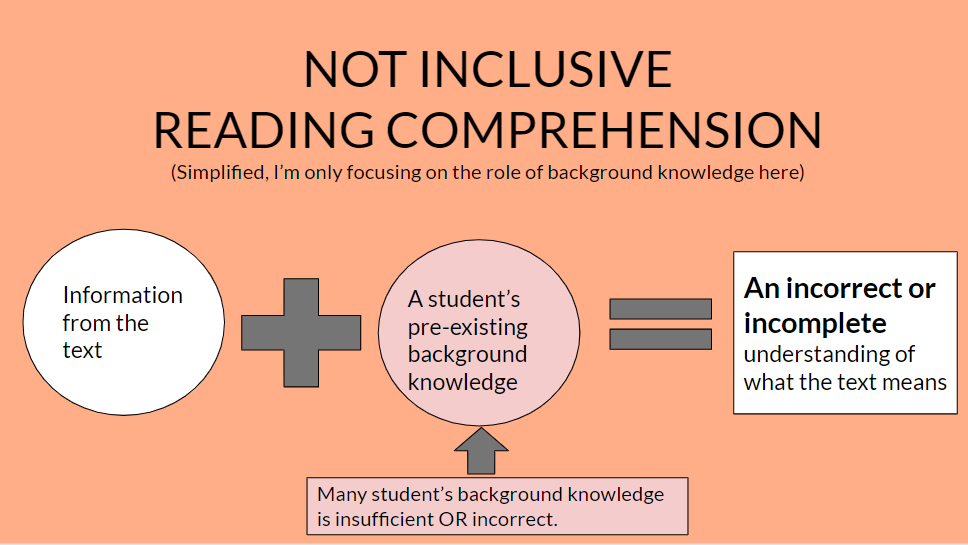
When students have insufficient or incorrect background knowledge, they build an incorrect or incomplete understanding of the text.
Researchers found that when weaker reading students read something that contradicted their prior knowledge, students would preference prior knowledge. When asked to recall the contents of an expository article, weaker readers were “much more likely to omit contradictory information from the text and replace with their misconception“.
The implications of that finding are enormous. If we do not ensure students are consolidating correct information, they may spend their whole lives using incorrect knowledge as a frame to understand the world around them. This is also troubling when we consider teaching practices such as inquiry that require students to learn via their own reading. These findings imply that students cannot do that without first being provided with the sufficient prior knowledge.
The implication for instruction is that teachers need to first explicitly teach enough of the facts and concepts students need to understand a text before a student can learn from reading. This is a complex process because we don't want to engage in superficial 'knowledge dumping' on students. If you're ready to see how it works, you can explore one of our upcoming workshops.
Join us on May 6th to see how the Literacy for Learning method can help you scaffold the knowledge students need to succeed
Here’s an example. Let’s say we ask students to read and analyse the issue of high rates of Indigenous imprisonment but we only rely on students’ prior knowledge. It is unlikely that our students have a deep and accurate understanding of:
The history of Australia’s Indigenous people
The government’s abuse of them
The way that poor mental health impacts social outcomes; and
How all of that increases the chance of someone ending up in the criminal justice system.
If we only rely on a student’s prior knowledge, we are likely to not only receive shallow responses from our students, but potentially reinforce incorrect ideas about certain social groups or issues. We entrench stereotypes.
The difference between activating prior knowledge and building knowledge
We all know the importance of activating students’ prior knowledge in order to enable them to engage in learning, but you cannot “activate” knowledge that is not there. And worse, as outlined earlier, we may be activating knowledge that is simply incorrect. The solution? Give students the background knowledge they need. Simples (well the idea is, but the process of effectively building background knowledge isn’t quite so simple).
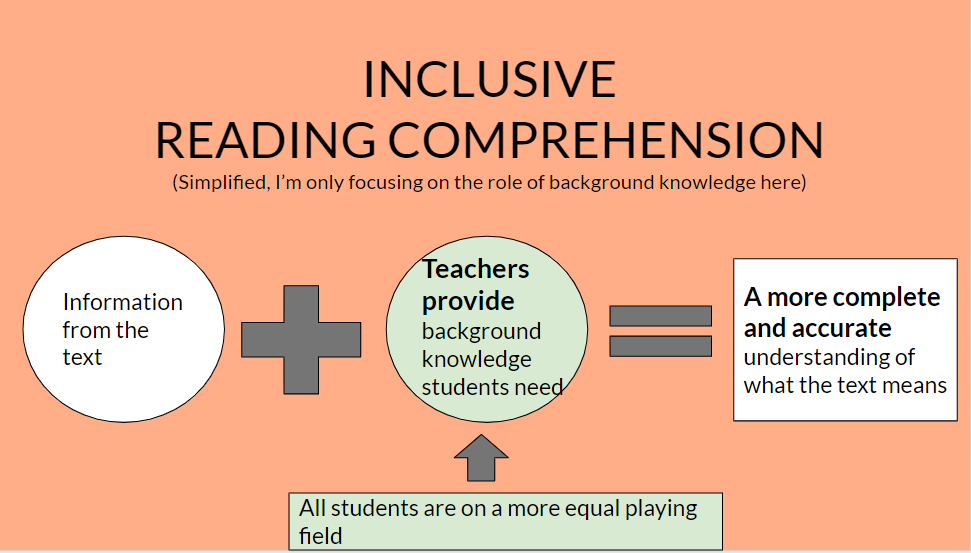
L4L supports teachers to ensure all students can succeed by ensuring we develop the knowledge students need before we ask them to learn from text or video
Reason 2: Teaching background knowledge puts all students on a (more) level playing field AND makes differentiation effortless.
Building knowledge fights inequities in the classroom
The prevailing thinking in teaching was that knowledge building is not needed due to the readily accessible knowledge on the internet (or elsewhere).
**I want to note that currently, that thinking has shifted in many schools only to be replaced by something that is arguably not much better, overloading students with too much knowledge that doesn't build the schemas empowered citizens or critical thinkers need.**
Furthermore, student-led learning encourages us to act as facilitators whose role it is to extract knowledge from students, or to base our teaching on the students’ interests or passions.
However, leaving it to parents (or the students themselves) to build their own knowledge of the world only exacerbates inequities between students and widens the gap between advantaged and disadvantaged students. It also holds stronger students back (see reason 3).
If we don’t take the time to explicitly teach our students the relevant knowledge for our unit of work, we are exacerbating inequality in the classroom. We are forcing students to rely on whatever they have learnt outside of the classroom. Student-centred but teacher-led learning is where we provide our students with the knowledge they need to overcome their inequalities, thereby ensuring all our students have the best chances of success.
Not teaching background knowledge forces us to differentiate more
A lot of the work we do as teachers in differentiating or scaffolding is an attempt to overcome foundational knowledge gaps and inequalities between students. We provide simpler versions of a text so students can access it. We provide summaries and writing frames. We scaffold the assessment because students are struggling to write about topics that they never understood. However, if a student’s challenges arise from a lack of background knowledge, many of these scaffolds will be ineffective.
On the other hand, once you have ensured that all students have more or less the same levels of background knowledge, you won’t need as many additional scaffolds and differentiation. Let me say this again: equalising background knowledge reduces the need for scaffolding and differentiation.
Once I equalised background knowledge I was able to select challenging texts with complex content without differentiating. By coupling knowledge building with close reading of texts, vocabulary instruction and sentence level writing instruction, all of my students were able to learn with the same material – from my lowest to my strongest. This made my life a lot easier.

By providing students with the knowledge they need to understand our unit, we close the gap in our classrooms
It’s important to note that background knowledge does not overcome all differences in reading comprehension. Students with poor decoding or low levels of vocabulary and understanding of sentence structures will still struggle in some respects. But building knowledge will provide them with much better chances of success. Building knowledge is also a good vehicle for teaching the other important elements of comprehension such as vocabulary and genre.
Reason 3: By building knowledge we snowball students’ learning.
The more knowledge a student learns, the easier it becomes to learn more.

Background knowledge allows students to learn more from text, which in turn increases their knowledge, which then allows them to learn more from text and so on.
The more knowledge students consolidate into their long term memory, the easier it is to acquire new knowledge without overburdening their working memory with foreign concepts. Furthermore, building knowledge allows students to understand more from text, which in turn increases their knowledge. This all allows them to learn new material more easily. It is like a snowball effect on learning.
By building students’ background knowledge, we set up our students to succeed in future learning.
Furthermore, if we do not challenge our strongest achieving students with new knowledge, they can become stagnate in their learning, even if they started from a place of greater knowledge. This is an unintended consequence of student-led learning.
Reason 4: Teaching background knowledge reduces teacher burnout and stress
Aside from reducing your workload by reducing the need to differentiate, building knowledge reduces teacher stress and burnout in other ways.
By choosing to teach background knowledge, you are in control of what your class focuses on. Increasing your autonomy and decision-making power is an evidence based way to reduce teacher burnout and stress.
This approach also reduces burnout by allowing you to bring your passions and interests into the classroom.
When you sit down to consider the background knowledge you need to build in your students, you have a wonderful opportunity to get creative and show students things you love. You can start to bring in artwork, songs, youtube clips, anything that interests YOU. This makes teaching more fun and engaging (for the students too 🙂)
For example, when I taught my English as an Additional Language (EAL/ESL) students Roald Dahl’s ‘Lamb to the Slaughter’, I wanted them to consider the power dynamics between men and women in the story and the social stereotypes that have been created around women.
To do this, I presented the students with information around sex and gender identity. We delved into the Harvey Weinstein Hollywood sexual harassment scandal. We explored how women are represented as innocent and virginal in K-Pop (which my students loved!). Coupled with close reading of the text, vocabulary and sentence structure instruction, the students brought significant depth of knowledge to our examination of Roald Dahl’s short story. It was a unit that was a joy to prepare and the students loved. They were successful because they had the information they needed to understand the issues in the text.

Laurie Simmons: Walking House – Artwork we examined to prepare for our analysis of ‘Lamb to the Slaughter’
Learn how to apply this in your classroom
It is challenging to unlearn things we have believed to be true or right for so long. It takes a lot of courage and dedication to change your ways. I know it was hard for me to discover that many of my teaching practices were not effective and not helping my students. These teaching practices created more work than the results they delivered. When I was brave enough to break from these patterns of teaching and unlearn what I had learnt, I truly became a better, more rested and joyful teacher.
Start your journey towards more focused and fulfilling teaching today by joining one of our online courses or workshops. The next one starts May 6th, you won’t regret it. Click image above for more detail.
