
Beyond Differentiation: Why Better Unit Design — Not More Adjustments — Supports Every Student
“Australia has made learning often a mile wide, but just an inch deep…
The challenge is to teach fewer things at greater depths.”
— Andreas Schleicher, Director for Education and Skills, OECD (2022)
Schleicher’s observation gets to the heart of the issue in many classrooms: we are designing teaching units that often overwhelm student brains and make learning difficult, if not impossible.
When learning is packed too tightly, too many concepts, too many texts, too many competing goals, students don’t thrive because their attention is fragmented and their working memory overburdened.
Many schools rely on differentiation to support struggling students. But what if the real issue isn’t the need for more adjustments, it’s the way we design our units? Cognitive load theory suggests that better curriculum design, not more differentiation, is what truly supports all learners.
What we explore in this post:
Why Differentiation Often Fails in Overloaded Classrooms
The Real Constraint: Working Memory
Why "Teaching Less" is Not Lowering Standards
How Cognitive Load Theory Improves Unit Design & Replaces Differentiation
Why Differentiation Often Fails in Overloaded Classrooms
Imagine two students we see commonly in our classrooms.
"Jack" struggles with reading and he disengages quickly. School feels difficult, and his behaviour sometimes masks that difficulty.
"Jane" performs well. She finishes tasks, complies with instructions, and appears successful but her thinking rarely deepens and she’s usually pretty bored.
Traditionally, we respond by differentiating. Jack receives simplified texts, content or reduced writing expectations. Jane receives an extension worksheet when she finishes early.
On the surface, this feels responsive but in reality, something more subtle happens. As the work changes the thinking is stunted.
For Jack, simplified tasks often mean reduced intellectual demand. For Jane, “extension” frequently means more work but not diving deeper. Meanwhile, the core lesson, the vehicle for delivering the base content, remains overcrowded and conceptually diffuse.
Differentiation becomes a compensatory strategy for curriculum design that isn't supportive of how brains learn.
Differentation has become a popular strategy in classrooms, but it isn't really addressing the root cause of student academic struggle
The Real Constraint: Working Memory
Cognitive load theory offers us a clearer explanation.
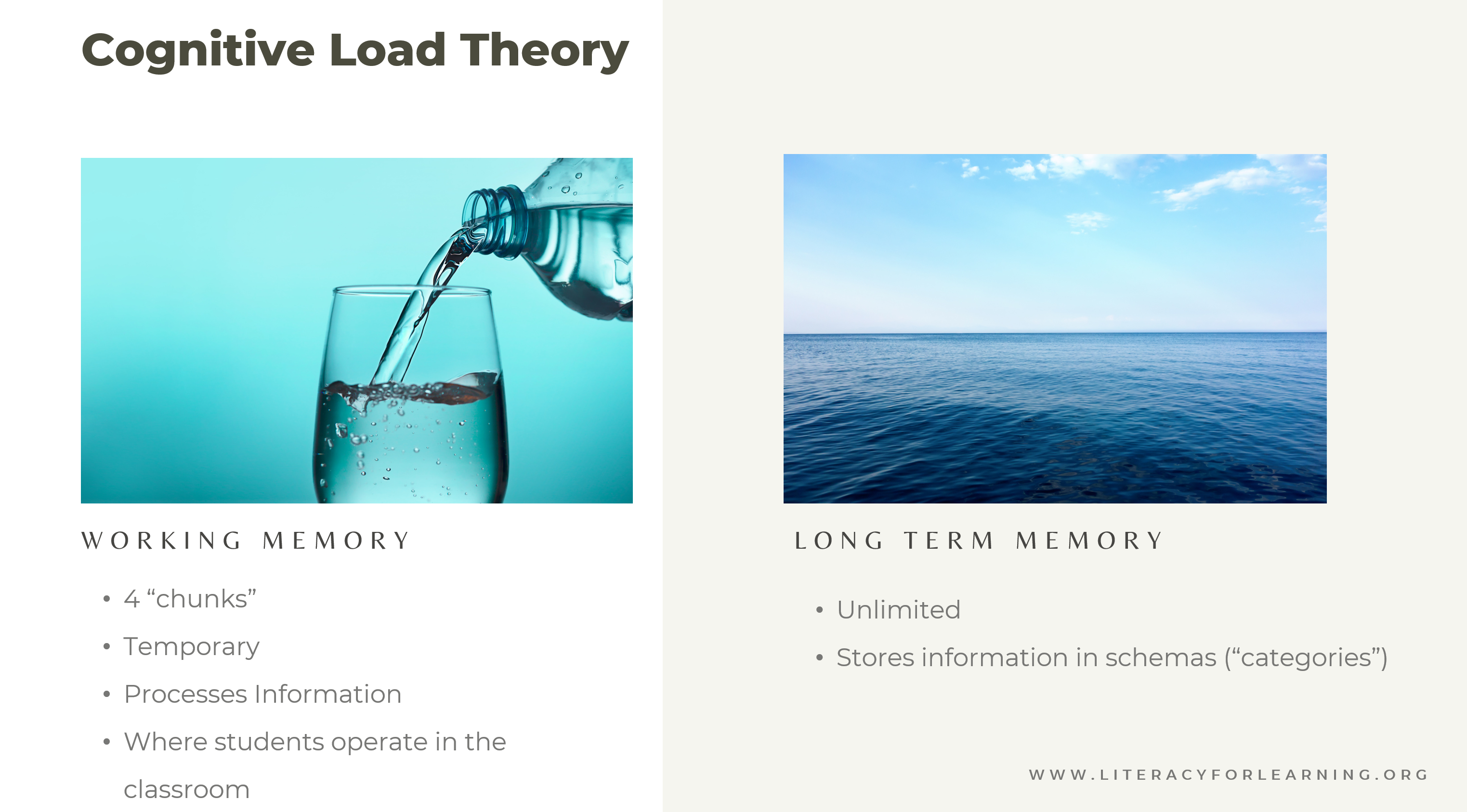
Working memory is what students are using in the classroom. Human working memory is limited. It can process only a small amount of new information at one time, whereas long-term memory, by contrast, is vast. It stores organised knowledge structures — schemas — that allow us to think fluently and deeply.
Learning occurs when new information is successfully consolidated into long-term memory. That consolidation requires repetition, retrieval, and feedback.
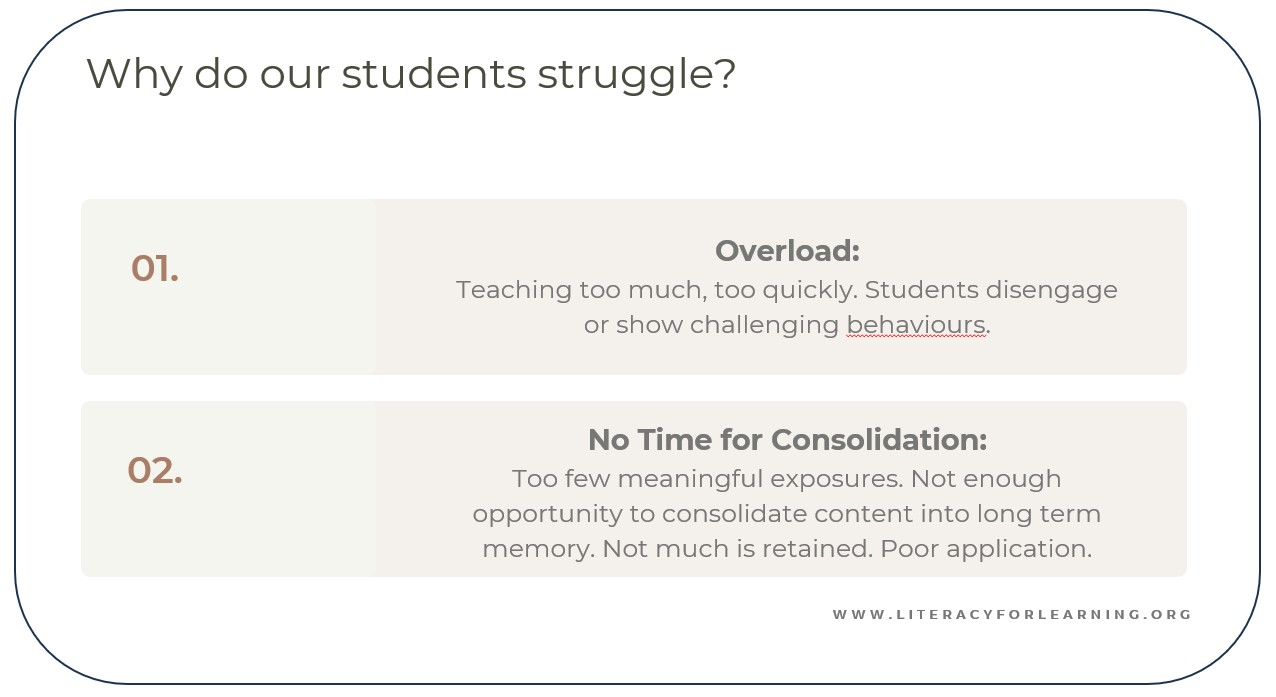
When a lesson introduces too many new elements at once it overloads working memory. Students may appear busy, reading, writing, discussing, but very little transfers into durable knowledge.
A student like Jack overloads and disengages and Jane might cope but her answers lack depth and critical thought. Without sufficient repetition and consolidation, she never consolidates the schemas required for deep analysis.
What appears to be a difference in ability is often a difference in cognitive load.
Why "Teaching Less" is Not Lowering Standards
If students require multiple exposures — research often suggests ten or more — to consolidate new knowledge, then our current units are frequently overpacked.
We attempt to cover entire novels, every aspect of broad historical periods, complex scientific systems, all within tight timeframes. Breadth replaces depth. Exposure replaces mastery.
The result is predictable: scaffolds, behaviour management, and relentless differentiation.
Teaching less is not about reducing rigour. It is about increasing coherence and ensuring our teaching units have clear throughlines.
When a unit is anchored around a single essential idea, a clear, arguable understanding that students revisit across weeks — cognitive load decreases. Each encounter strengthens prior knowledge rather than competing with it.
In English, this might mean exploring one central theme in depth rather than trying to cover them all. Exploring only one theme allows us to build in time to develop vocabulary and the writing skills students also need working up to an essay.
In History, this could mean anchoring a unit around a coherent conceptual thread, for example, analysing why periods of progress advantage some groups more than others, and revisiting that idea through texts, sources, and discussion across several weeks.
In primary literacy, it could mean structuring reading and writing around one substantial concept, such as how human intervention shapes the environment, allowing students to build knowledge, vocabulary, and writing cumulatively.
The intellectual demand remains high but with less fragmentation.
How Cognitive Load Theory Improves Unit Design & Replaces Differentiation
When units are designed with cognitive load in mind, several shifts occur.
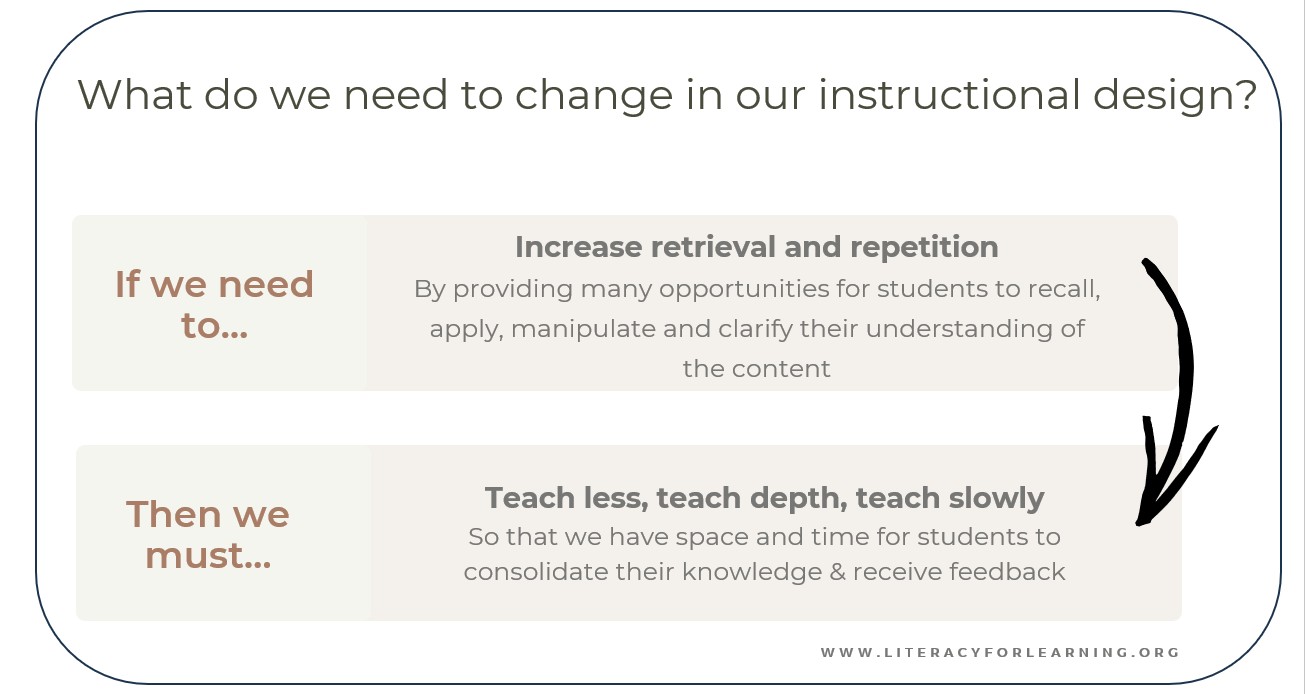
First, new content is introduced more slowly and deliberately and non-essential material is removed. Using a tool such as an essential idea to limit what we teach also helps us to resist tangents that overwhelm student's minds.
Second, retrieval becomes routine. Students revisit key ideas through reading, writing, discussion, and low-stakes testing. Feedback is immediate and corrective, preventing misconceptions from solidifying.
Third, coherence becomes visible. Each lesson connects explicitly to the essential idea, strengthening the through-line of the unit.
In such classrooms, Jack is supported not because the work is easier, but because it is clearer, more structured and Jack has multiple opportunities to consolidate what we want him to learn. Jane is extended not through additional tasks, but through deeper engagement on the same ideas with greater demands.
Differentiation, in its reactive form, becomes less necessary.
The curriculum itself carries more of the load.
A Design Challenge for Schools
The implication is significant. If cognitive overload is a structural issue, then no amount of worksheets, differentiated tasks, or extensions will resolve it.
What must change is the architecture of our units.
This requires restraint — the discipline to prioritise what matters most. It requires time for repetition and feedback. And it requires trust that depth produces equity more reliably than breadth.
Small shifts in design can alter classroom experience profoundly. Students feel more capable because they are not perpetually overwhelmed. Teachers spend less time compensating and more time refining understanding.
The work does not become easier.
It becomes clearer.
Want More? Explore these learning opportunities
If you would like to see how this approach reshapes an entire unit in practice — including concrete classroom examples — you can watch the full webinar in our resources and community hub.
For more on leveraging the science of reading to support all learners, join up upcoming webinar.
And for those ready to redesign their own curriculum, our upcoming workshop explores how cognitive load theory and the science of reading inform the design of coherent, brain-aligned units that genuinely support all learners.
Because supporting every student does not require more differentiation.
It requires better unit and lesson design.
