Upcoming professional learning
Our professional learning supports teachers to apply the science of learning in real classrooms.
Upcoming professional learning
Our professional learning supports teachers to apply the science of learning in real classrooms.
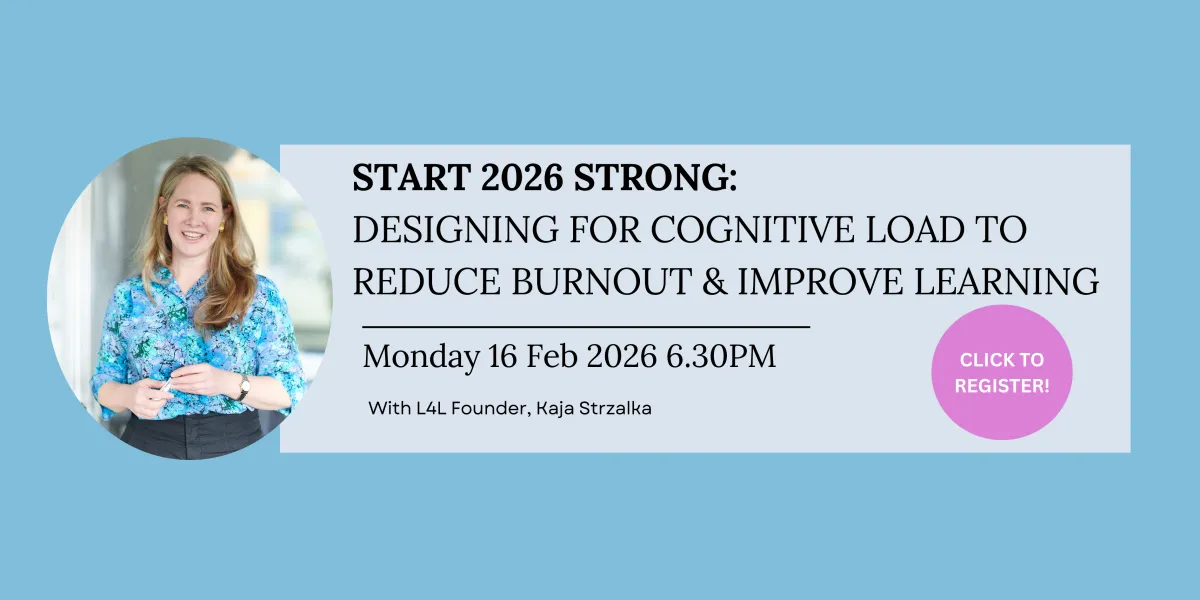
Start 2026 Strong: Designing for Cognitive Load to
Reduce Burnout & Improve Learning
Re-thinking Literacy - What the Science of Reading Means for Every Classroom
Monday February 16
Online
6.30PM - 7.30PM (AEDT)
Monday March 16
Online
6.30PM - 7.30PM (AEDT)
This session will be recorded
Our next professional learning session focuses on a topic that is dominating education right now: the Science of Reading and in particular, comprehension. This session is tailored to secondary teachers but is equally applicable to primary teachers seeking to develop comprehension.
Phonics.
Decoding.
Comprehension skills and strategies.
Background knowledge and knowledge rich curriculum.
The conversation is everywhere — but many teachers are still asking a simple question:
What does it actually mean for my learners in my classroom?
In this free webinar, we step back from the noise to explore what the Science of Reading really tells us about how students learn how to read and what teachers can do to support them.
If you’ve ever wondered why students avoid reading, struggle to understand what they read or hear, or rely heavily on the teacher instead of working independently, this session is for you.
Our first PD of the year focuses on how to use Cognitive Load Theory to make planning easier and ensure learning transfers beyond the lesson, especially for struggling students.
“Understanding Cognitive Load Theory has been the biggest game-changer for my teaching and my students’ learning.”
We hear this from teachers all the time, so this is what we wanted to start the year with.
This free webinar will focus on a foundational idea that can make a real difference to how your classroom runs day to day.
If you’ve ever felt pressure to cram content into a unit, found it difficult to engage struggling students, or wondered why students forget what you’ve taught, this first session is for you.
Detail
Detail
Many teachers tell us they are seeing the same patterns across year levels and subjects:
“Students hate reading, have low literacy, or say texts are too hard — and I don’t know how to help them.”
Learning through reading becomes a key expectation from the middle primary years and is critical for success in secondary school.
Yet many teachers, especially secondary, have never been taught what reading actually is, how it occurs in the brain, or how to effectively support struggling students in the classroom. Common responses—such as choosing “engaging” or simplified texts—can unintentionally limit students’ long-term outcomes.
This session explores how we can maintain high expectations for all students while supporting them to succeed through insights from the science of reading.
Suitable for both primary and secondary teachers, this session is designed for educators who want greater clarity and rigour in their practice—whether these ideas are new to you or you’re looking to apply them more intentionally.
The session will explore:
This session is built around the L4L planning principle “teach less, teach depth.”
We’ll explore the science behind why this works and how ideas from Cognitive Load Theory can guide smarter planning decisions, so learning builds, endures, and is more accessible for students who find learning challenging.
This session is suitable whether these ideas are new to you or you’re looking to use them more intentionally. It’s designed for primary and secondary teachers who want to start the year with clarity, focus, and rigour, without burning out.
The session will explore:
What the Science of Reading actually is — and why it’s often misunderstood
Why comprehension breaks down even when students can technically read the words
Why many common classroom approaches to literacy don’t produce the outcomes we expect
Why literacy is not just an English issue, but something that shapes learning in every subject
What current debates around the Science of Reading mean for teachers in both primary and secondary settings (beyond phonics)
Why students struggle and disengage
Why unit and lesson design matters more than motivation or engagement
Why some learning endures beyond the lesson and other learning is forgotten
How teaching that works with the brain supports both learners and teachers
Stay up to date new posts and PD opportunities
Read our latest posts
Beyond Differentiation: Why Better Unit Design — Not More Adjustments — Supports Every Student
Why differentiation often fails — and how cognitive load theory reshapes unit design to support struggling and high-achieving students. ...more
Science of Learning ,Cognitive Load Theory Curriculum & Instruction &Cognitive Science in Education
March 04, 2026•6 min read

Back to Basics Teaching: How to Achieve More with Less
Teaching has become overcomplicated. Learn how back-to-basics lesson design grounded in cognitive science improves student learning while reducing teacher workload. ...more
Science of Learning ,Cognitive Load Theory Teacher Wellbeing & Professional Practice Teacher Burnout &Secondary Teaching
February 13, 2026•6 min read

Why the 'Great Mother Teacher' Myth Must Die
Exploring the ‘Great Mother Teacher’ myth: how overextending care undermines teaching, student learning, and teacher wellbeing. ...more
Teacher Wellbeing & Professional Practice ,Teacher Burnout
November 02, 2025•11 min read